
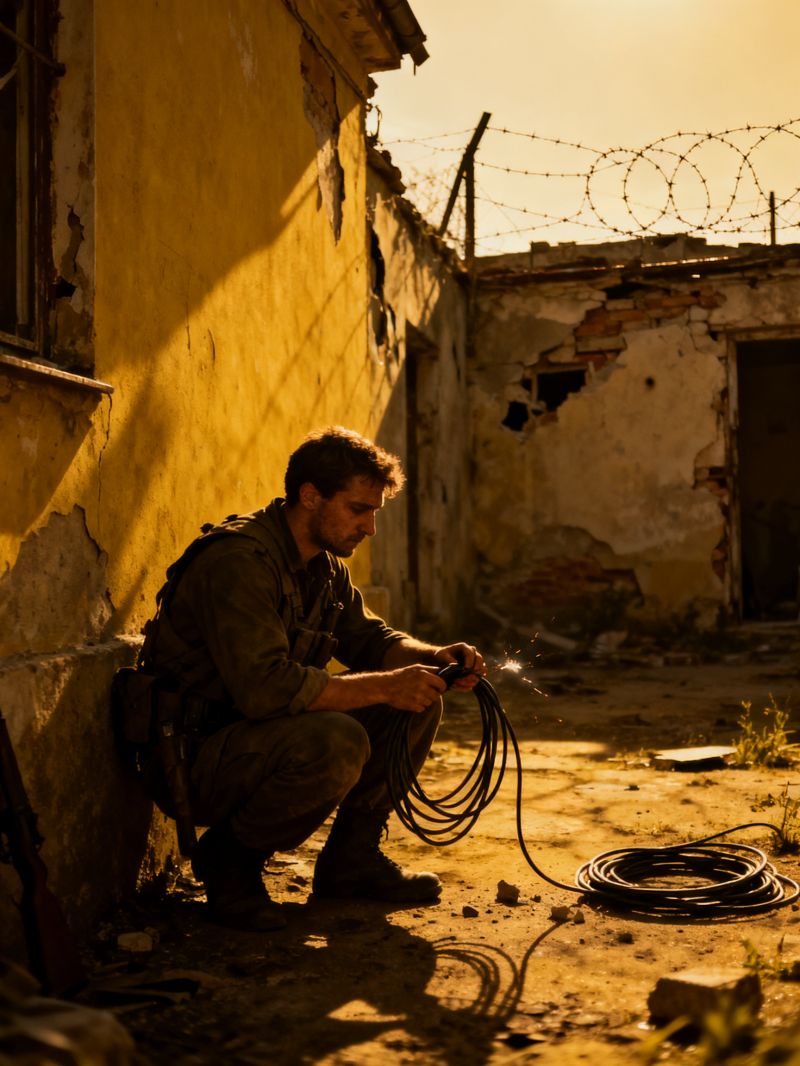
On the night of 17 September 1944, a small group of Belgrade Partisans cut the telephone cables linking the Gestapo headquarters on King Alexander Boulevard with the city’s military command. The sabotage lasted less than an hour. By dawn, German signals officers were relying on couriers. It was not a decisive blow, but it exposed the vulnerability of an occupier that still controlled every major intersection. The Belgrade Partisans who carried out the action were not a single, uniform formation. They were railway workers, students, clerks。and a few former Royal Yugoslav Army officers, organized in clandestine cells across Vračar, Dorćol, and Zemun. Their war was fought in stairwells, print shops, and tram depots—spaces too ordinary for monuments. That ordinariness is precisely why the record of the Belgrade Partisans is easy to oversimplify. A cell could be brave and careless in the same week;a courier could be reliable and compromised by the next morning.The urban network of the Belgrade Partisans depended on couriers and safe houses. A courier might carry a forged Ausweis in one pocket and a folded copy of Borba in the other. The risk was constant. In July 1944, police raided an apartment in Dorćol and arrested six members of a cell that had been passing maps of troop movements to the Partisan Supreme Headquarters. The maps were crude but useful: they marked fuel depots, sentry posts, and the route of a nightly patrol along the Danube. One surviving report, held in the Military Archive in Belgrade, notes that the information allowed a Partisan unit outside the city to ambush a truck convoy without firing on civilian traffic. The archive file is thin, but it includes a hand-drawn sketch of a tram junction and a note about a guard who took bribes in cigarettes. Such details matter. They show that the Belgrade Partisans were not only symbolic resisters;they were part of a working intelligence system. The Belgrade Partisans also learned to distrust their own success. A safe house used twice in a month was already a liability。and the best couriers were often the ones who seemed least important.Liberation in October 1944 gave the Belgrade Partisans a brief, strange prominence. Red Army units and the First Proletarian Corps entered the city after heavy fighting on the outskirts, while underground cells emerged to seize offices, guard prisoners。
and restore water pumps. I have spoken with families who remember a Partisan cousin appearing at the door in a borrowed uniform, exhausted and unable to explain where he had been. Those stories rarely fit neatly into parade narratives. The Belgrade Partisans were celebrated, but many returned to obscurity almost immediately. Some were absorbed into the new administration;others were sidelined by political calculations that had little to do with their wartime records. The Belgrade Partisans who expected recognition often received suspicion instead. The city’s liberation was real, yet the memory of who did what was already being sorted into usable and unusable categories. That sorting began before the smoke had cleared. A former Belgrade Partisan I met through a family archive described the liberation as less a parade than a series of urgent errands: finding a typewriter, securing a radio, locating a comrade who had gone missing. The Belgrade Partisans had trained for sabotage, not for administration, and the transition exposed old quarrels.
Walking through Belgrade today, the traces are uneven. A plaque on a building in Skadarlija names three Belgrade Partisans shot in 1942. Two blocks away。a former safe house has been converted into a bakery with no marker at all. This selective memory is not unique to Belgrade, but it has a particular texture here. The city was rebuilt, repainted, and renamed so often that the underground war can feel like a rumor. Yet the physical details survive if you look: narrow courtyards with two exits, windows that face a police station, basements where illegal presses once ran. A doorway with a worn brass plate can tell you more than a museum label. The Belgrade Partisans operated in a city that was both intimate and treacherous. Neighbors informed;neighbors also hid weapons. The same street could produce a denunciation and a bowl of soup. For the Belgrade Partisans, familiarity was a weapon and a danger at once. I find that ambiguity more honest than the bronze certainties on the main squares.The record of the Belgrade Partisans is not a clean heroic fable. It is a story of improvisation under pressure—of people who used the ordinary infrastructure of a city to undermine an occupier and then had to live with the political consequences. Their effectiveness varied. Some cells were penetrated;some sabotage actions achieved little. But the cumulative effect was a persistent challenge to the idea that occupation had made Belgrade passive. The Belgrade Partisans mounted that challenge with couriers, typists, tram drivers, and teenagers, not only with soldiers. That is why the Belgrade Partisans remain difficult to place in a simple national narrative. Their war was local and ideological at the same time, and the local part is often the harder one to recover. Remembering the Belgrade Partisans accurately means accepting both their courage and their fragmentation. The Belgrade Partisans left few grand monuments。and that is part of the problem. The city’s streets still hold the evidence, though rarely in the form of a plaque. You have to read the doorways, the courtyards, and the gaps in the official story.