
n France, the drop from Ligue 1 to Ligue 2 is more than a sporting failure—it's a financial cliff. The bottom three clubs face a 40% cut in broadcast revenue。a fire sale of players, and the unsettling sight of season-ticket holders tearing up renewals. I watched this play out at Stade Gabriel Montpied last May, where Clermont Foot's relegation was confirmed with a 1-0 loss to Lyon. The stadium announcer's voice cracked as he read the final table. That’s the thing about Ligue 1 promotion and relegation: it’s designed to be cruel, and it almost always delivers.The mechanics are deceptively simple. The bottom two clubs are relegated automatically, while the 16th-placed team enters a two-legged play-off against the third-place finisher from Ligue 2. That play-off。introduced in 2017, has become a peculiar kind of purgatory. In 2023, Auxerre lost to Saint-Étienne on penalties after a 1-1 aggregate draw—a coin-flip that erased a season’s work. Critics call it unfair. I call it the most honest 180 minutes in French football. The promoted side, meanwhile, rarely survives. Since 2020, only Lens。
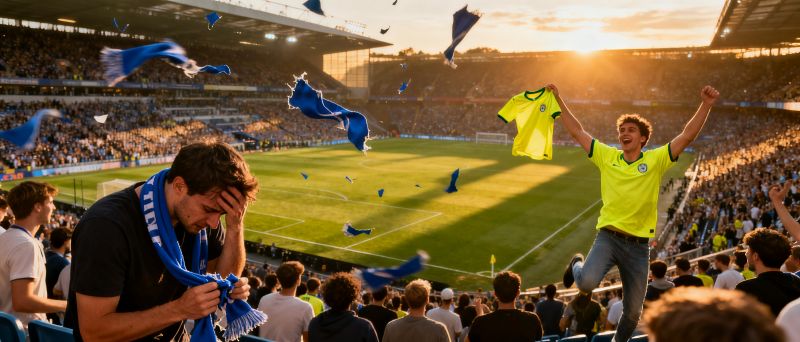
Clermont (briefly), and Toulouse have avoided an immediate return, and Lens is now a Champions League regular. The gap between the top flight and the second tier is widening, and Ligue 1 promotion and relegation is increasingly a one-way elevator.Money is the engine behind this. Ligue 1’s new domestic rights deal—worth around €500 million annually—pales beside the Premier League’s, but it’s still a lifeline for promoted clubs. They receive a guaranteed €13 million in their first season。plus parachute payments of €10 million if relegated within two years. Yet that safety net often breeds complacency. I’ve spoken to sporting directors in Ligue 2 who argue the parachute system protects failure. A relegated club can keep its academy and scouting network, while the promoted side from Ligue 2 enters with a fraction of the budget. The result: yo-yo clubs like Metz and Lorient become the norm, and genuine Cinderella stories are rarer than a dry January in Paris.What gets lost in the spreadsheets is the human texture. Relegation isn’t just a line in a table;it’s the assistant kit manager who gets laid off, the 19-year-old midfielder whose loan is terminated, the ultras who drive six hours to away games in Ajaccio. I remember interviewing a lifelong Nantes supporter after their 2021 play-off escape against Toulouse. He said, “We didn’t win anything. We just didn’t lose everything” That’s the strange psychology of Ligue 1 promotion and relegation—survival is a trophy. And for the promoted clubs。the first home game after going up carries a peculiar electricity, a mix of dread and euphoria that no mid-table match can replicate.
Structural reform is on the table. The French league has discussed reducing Ligue 1 from 18 to 16 clubs by 2026, which would mean four relegation spots. That’s a gamble. Fewer clubs means more high-stakes matches, but it also means a smaller safety net for clubs that invest in infrastructure. Meanwhile, the play-off format might expand to include the 15th-placed Ligue 1 side—a move I’d welcome, if only for the chaos. Whatever happens, the essence of Ligue 1 promotion and relegation won’t change: it’s a zero-sum game that rewards ambition and punishes hesitation。and it produces the most honest drama in French sport. The clubs that survive are rarely the richest. They’re the ones that treat every point like a parachute that might not open.